
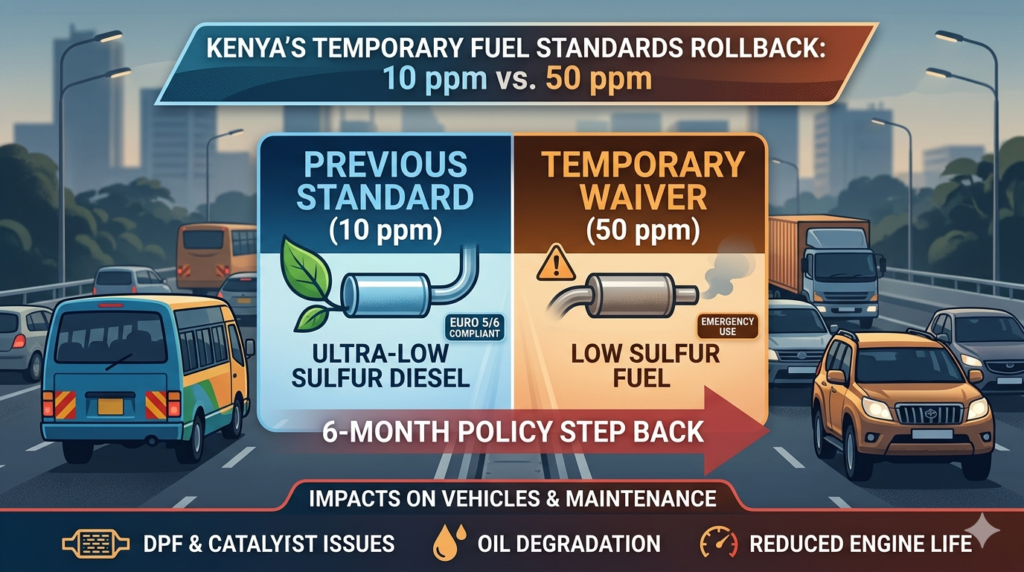
For the past several years, the narrative surrounding the Kenyan automotive and energy sectors was one of steady progression. We watched the Kenya Bureau of Standards (KEBS) and regional East African bodies push aggressively toward the global gold standard of fuel refinement: Ultra-Low Sulfur Diesel (ULSD) and clean Premium Motor Spirit (petrol) capped at a pristine 10 parts per million (ppm) of sulfur.
This shift was a massive win for environmental advocates looking to clean up urban air quality in major towns, and an even bigger win for vehicle owners driving modern Euro 5 and Euro 6 vehicles, whose complex emission control systems depend entirely on clean fuel to survive.
However, a sweeping policy directive issued on April 30, 2026, completely upended that trajectory.
The Policy Shift: What Just Happened?
In an emergency press release, Trade Cabinet Secretary Lee Kinyanjui announced that the Ministry of Investments, Trade, and Industry had approved a temporary, six-month waiver relaxing Kenya’s strict fuel cleanliness parameters.
Under this waiver, the maximum allowable sulfur limit for both Automotive Gasoil (Diesel – KS EAS 177:2025) and Premium Motor Spirit (Petrol – KS EAS 158:2025) has been legally raised five-fold, jumping from the targeted 10 ppm up to 50 ppm.
This decision represents a classic geopolitical compromise: economic survival over environmental perfection.
The “Why”: Pragmatism in the Face of a Global Supply Crisis
The decision to temporarily degrade Kenya’s fuel standards was not a step backward taken willingly; it was forced by severe supply shocks on another continent.
Following severe international conflicts in the Middle East—specifically involving critical maritime choke points like the Strait of Hormuz—the global logistics routes for refined petroleum products have been heavily constrained. Sourcing highly specialized, ultra-clean 10 ppm fuel became incredibly difficult and prohibitively expensive for Kenyan oil marketers.

Had the government dug its heels in and insisted on the strict 10 ppm standard, Kenya would have faced two immediate realities:
- Severe, widespread dry pumps at petrol stations nationwide.
- Uncontrollable price spikes at a time when EPRA fuel reviews had already pushed pump prices past the Sh200 per liter mark, triggering fare hikes by public transport operators and driving up the baseline cost of living.
By relaxing the standard to 50 ppm until late October 2026, the Ministry of Energy and Petroleum has allowed local oil marketers to tap into a significantly larger and more accessible pool of international fuel cargoes, effectively safeguarding the country’s economic mobility.
The Technical Fallout: What This Means for Your Vehicle
While 50 ppm is historically considered “Low Sulfur” (especially compared to the 500 ppm to 3,000 ppm fuel Kenya utilized over a decade ago), the sudden return to 50 ppm poses a distinct technical challenge for late-model, high-spec vehicles.
1. DPF and Catalyst Poisoning

Modern vehicles imported from highly regulated markets (like the UK, Europe, Japan, and Australia) are equipped with Diesel Particulate Filters (DPF) and advanced catalytic converters designed exclusively for 10 ppm fuel. Higher sulfur levels introduce heavier particulate matter (soot) that coats and “poisons” the sensitive precious metal catalysts inside these systems. Over time, the DPF cannot properly regenerate (self-clean), leading to premature clogging, severe exhaust restrictions, and persistent dashboard warning lights.
2. Rapid Engine Oil Degradation
When fuel with higher sulfur levels combusts, it generates sulfur dioxide, which reacts with moisture to form trace amounts of sulfuric acid. This acid escapes past the piston rings and contaminates the engine oil, a process known as oil acidification. The acid rapidly strips the oil of its protective additives, accelerating internal engine wear and sludge formation.
Actionable Strategy: Surviving the 6-Month Window

If you are currently driving or managing newer, Euro 5/Euro 6 compliant petrol or diesel vehicles on Kenyan roads, you must proactively adjust your preventative maintenance routines until this emergency waiver expires in late 2026:
- Shorten Oil Change Intervals: Do not push your vehicle to its maximum manufacturer-recommended oil life. If you typically change your engine oil every 10,000 km, reduce that interval to 5,000 km – 7,500 km to neutralize the accelerated acid buildup.
- Prioritize High-Tier Stations: Stick to major oil marketers who utilize high-quality additive packages at the pump. These additives include detergents that keep fuel injectors clear of the extra deposits associated with higher sulfur combustion.
- Initiate Passive DPF Regeneration: Avoid allowing modern diesel vehicles to spend their entire operational life idling in dense urban traffic. Take the vehicle on a weekly, uninterrupted 30-to-45-minute highway run at sustained speeds above 80 km/h. This raises the exhaust gas temperature sufficiently to clear out trapped soot before it tightly packs and ruins the filter.
The Outlook: The current 50 ppm framework is fundamentally an economic shield. The government has made it clear that this waiver is strictly temporary. Barring further prolonged geopolitical disruptions, Kenya is fully expected to reinstate its rigorous 10 ppm clean fuel mandates by November 2026, aligning our local automotive market right back with global environmental standards.
Compiled by Sipitali Shitsukane
Car Enthusiast, Car Imports Consultant.