
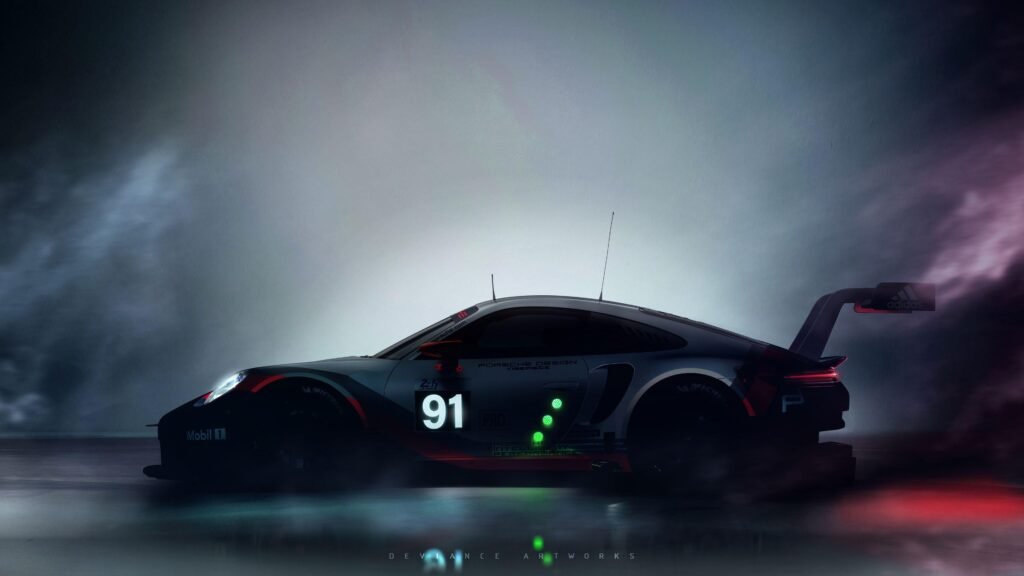
The Porsche 911 GT3 occupies a rare space in high-performance motoring: it isn’t chasing raw, straight-line speed metrics or bloated horsepower totals. Instead, it is built with a razor-sharp focus on weight reduction, high-rpm atmospheric engine response, and absolute track precision. Born out of Porsche’s motorsport division in Weissach, the GT3 is essentially a road-legal homologation model that bridges the gap between everyday sports cars and dedicated Cup racers.
The Heartbeat: A 9,000-RPM Engine
While virtually all modern supercars rely on turbocharging or hybrid assistance for instant low-end torque, the 911 GT3 stays firmly rooted in traditional driver engagement.
- Naturally Aspirated Flat-Six: The GT3 relies on a free-breathing 4.0-liter engine equipped with individual throttle bodies.
- Extreme Redline: The engine revs all the way to a screaming 9,000 rpm, generating over 500 horsepower.
- Transmission Choices: Porsche offers both an ultra-fast 7-speed PDK dual-clutch transmission for maximum lap-time performance and a 6-speed GT manual transmission for raw driving feedback.
Evolution Through the Generations
Since its 1999 debut, each GT3 iteration has systematically refined handling dynamics and aerodynamic efficiency while keeping total curb weight low.
| Generation | Engine / Power | Key Technical Highlight |
| 996 GT3 (1999–2005) | 3.6L Flat-6 (360–381 hp) | Introduced the race-derived “Mezger” engine and set the benchmark for driver feedback. |
| 997 GT3 (2006–2011) | 3.6L–4.0L Flat-6 (415–500 hp) | Introduced Active Suspension Management (PASM) and the legendary 4.0 RS. |
| 991 GT3 (2013–2019) | 3.8L–4.0L Flat-6 (475–500 hp) | Adopted rear-axle steering and introduced the winged-wing vs. subtle “Touring” package dichotomy. |
| 992 GT3 (2021–Present) | 4.0L Flat-6 (502–510 hp) | Added a race-derived double-wishbone front suspension and a swan-neck rear wing. |
Race-Car Chassis & Aerodynamics
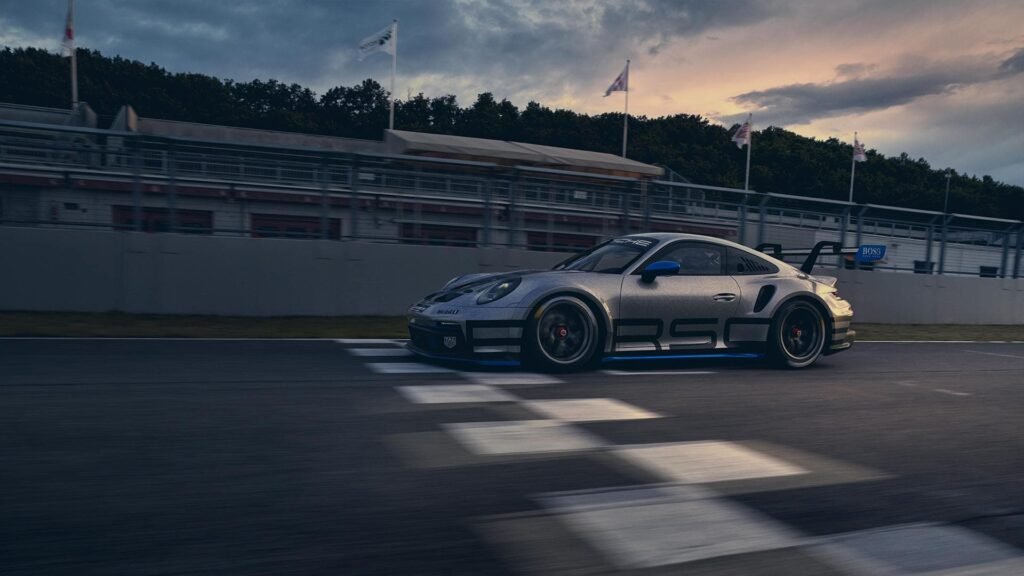
The modern 992-generation GT3 marked a major departure for Porsche. Rather than using standard MacPherson struts up front, engineers fitted a double-wishbone front suspension directly derived from the 911 RSR endurance race car. Combined with rear-axle steering and functional downforce elements like top-mounted “swan-neck” rear wing brackets, the setup maximizes front-end grip during turn-in while reducing aerodynamic drag under high speeds..
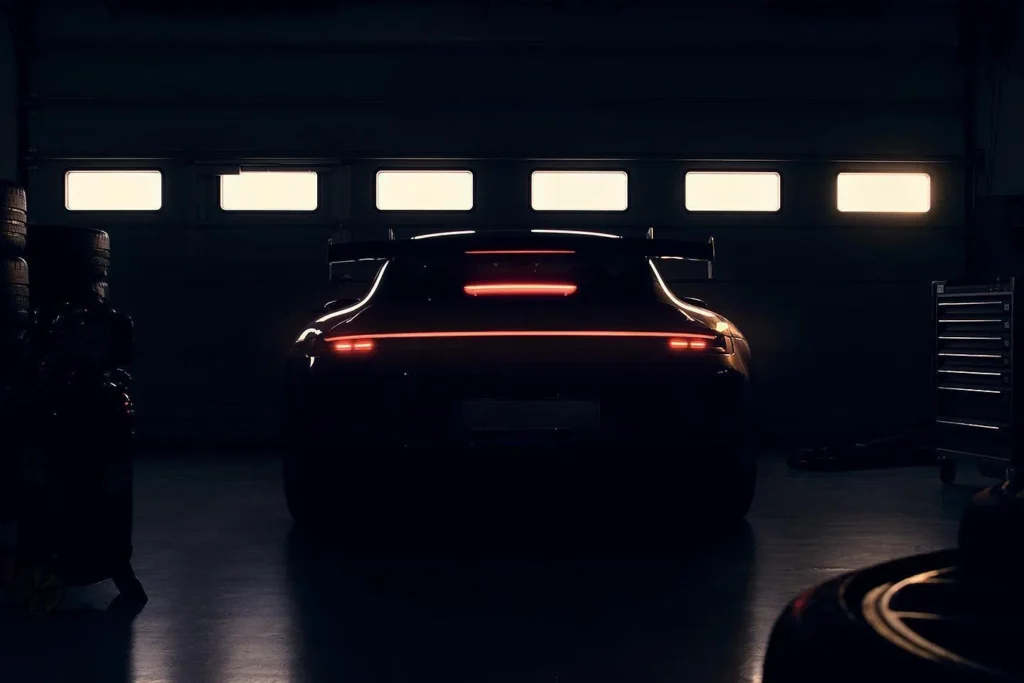
Whether equipped with the aggressive fixed rear wing or in the discrete GT3 Touring trim—which swaps the wing for an automatically deploying rear spoiler—the GT3 remains one of the purest expressions of high-rpm, track-focused driving available.
The 911 GT3 vs The 911 GT3 RS
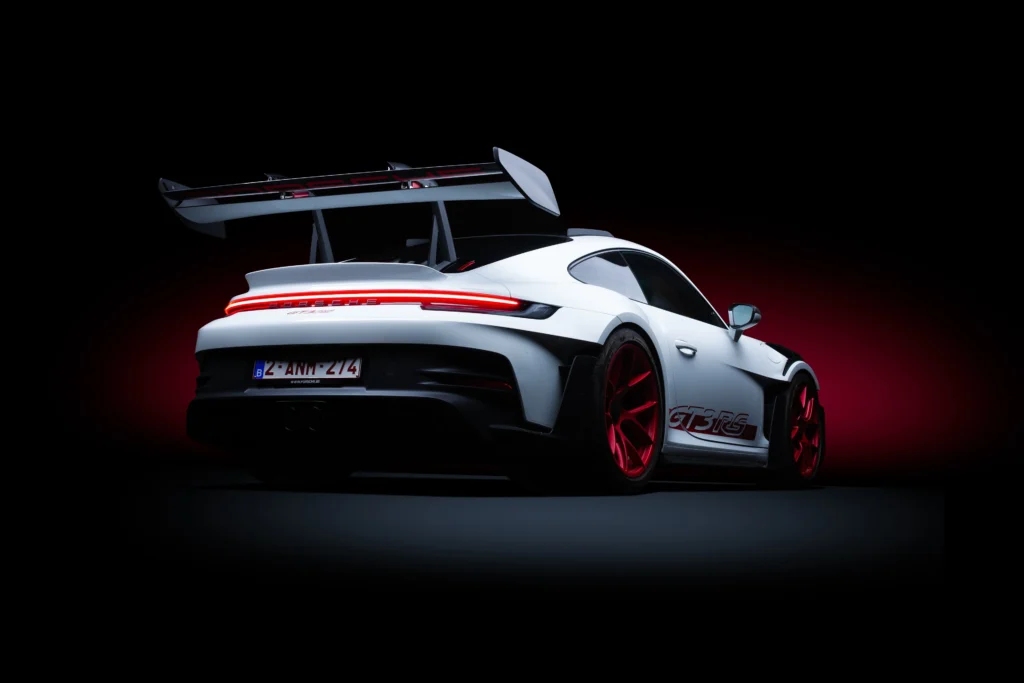
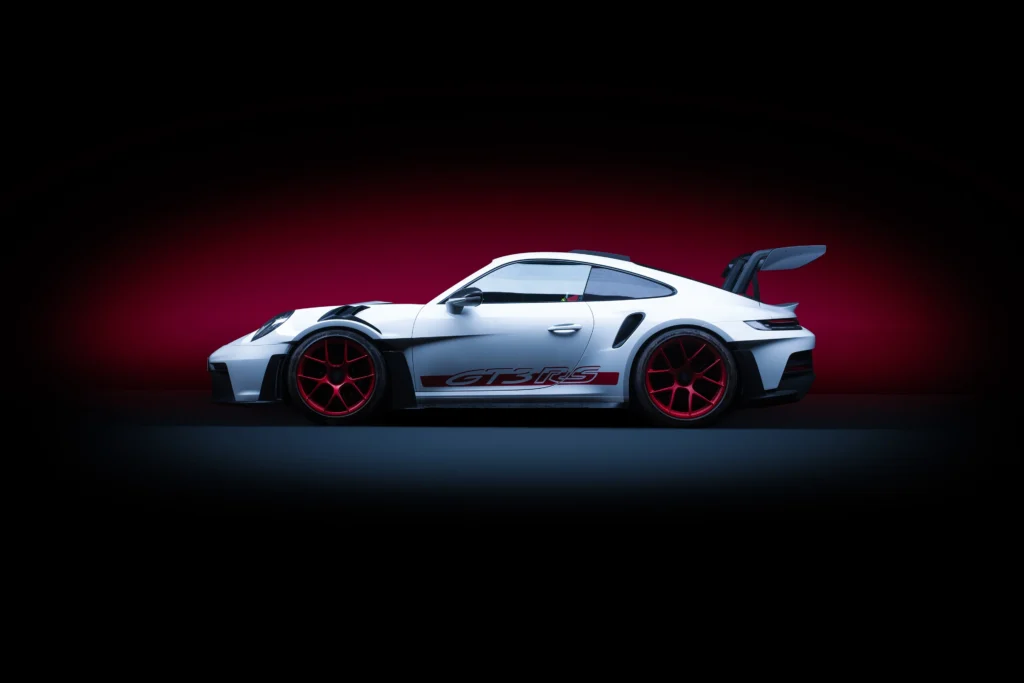
While the 911 GT3 is designed as a ultimate dual-purpose weapon—equally capable on winding back roads and track days—the GT3 RS (Rennsport) drops virtually all street compromises. Using the latest 992-generation as the benchmark, the distinction boils down to three core pillars: Aerodynamics, Power, and Suspension.
Aerodynamics: Passive vs. Active Downforce
The primary difference lies in how the two cars manage airflow. The GT3 relies on traditional static aero, whereas the GT3 RS is designed around motorsport-grade active aerodynamics.
The GT3 Wing: Features a fixed, top-mounted “swan-neck” rear wing manually adjustable for track days. It generates around 385 kg (849 lbs) of downforce at high speed.
The GT3 RS Active System: Generates a staggering 860 kg (1,895 lbs) of downforce at 177 mph—roughly three times that of the standard GT3.
- Its rear wing sits higher than the roofline for the first time on a road-going Porsche.
- Features an F1-style Drag Reduction System (DRS) that flattens the wing at the push of a button for straight-line speed, or acts as an air brake during emergency braking.
Cooling Concept: The standard GT3 uses a traditional three-radiator setup with a functional front trunk (“frunk”). The GT3 RS replaces the frunk entirely with a single, massive angled radiator taken directly from the 911 RSR race car. This frees up space in the front bumper for active underbody air diffusers.
Power & Drivetrain
Both cars share the iconic, naturally aspirated 4.0-liter flat-six engine that revs to a screaming 9,000 RPM, but their execution differs slightly:
- Output:
- 911 GT3: 502 hp / 346 lb-ft of torque.
- 911 GT3 RS: 518 hp / 343 lb-ft of torque. The bump in horsepower comes from modified camshaft profiles, rigid valve drives, and individual throttle bodies derived from racing motors.
- Gearbox:
- 911 GT3: Available with either a 6-speed GT manual or a 7-speed PDK dual-clutch transmission.
- 911 GT3 RS: Available exclusively with a 7-speed PDK with shorter overall gear ratios to maximize corner-exit acceleration.
Note: Because of the massive aerodynamic drag created by its giant wings, the GT3 RS actually has a lower top speed (184 mph) than the standard GT3 (197 mph), but it cornering speeds and lap times are vastly superior.
Suspension & Chassis Tuning
Both models feature a race-derived double-wishbone front suspension, but the GT3 RS gives the driver unprecedented control right from the steering wheel.
| Feature | 911 GT3 | 911 GT3 RS |
| Front Track | Standard widebody | 29 mm wider track with teardrop-shaped suspension links that generate up to 40 kg of front downforce alone. |
| Bushing Mounts | Combination of rubber and ball joints. | Fully solid-uniball bearings across the entire suspension for zero mechanical flex. |
| On-the-Fly Adjustments | Mechanical adjustments require tools in the pit lane. | 4 Rotary Wheels on Steering Wheel: Adjust front/rear damper Bump & Rebound, Torque Vectoring (PTV+), and Traction Control stage-by-stage while driving. |
| Brake Anti-Dive | Standard pitch control | Pitch-reduction geometry reduces front-end body dive under extreme braking by up to 30%. |
Compiled by Sipitali Shitsukane
Motoring Enthusiast, Vehicle Imports Consultant