
When people talk about cars, conversations often revolve around engine size, horsepower, torque, turbochargers, fuel economy and cylinders. But beneath all of those specifications is a mechanical system that determines how efficiently an engine can breathe: the valvetrain.
You may have seen terms such as OHV, SOHC and DOHC on vehicle specifications and wondered what they actually mean. These terms do not describe how many cylinders an engine has, whether it is petrol or diesel, or whether it is turbocharged. Instead, they describe where the camshaft is located and how it operates the engine’s intake and exhaust valves. Understanding these three designs gives you a much better picture of why some engines are designed around low-speed torque and durability, while others are capable of breathing efficiently at high engine speeds.
The Starting Point: What Does a Camshaft Actually Do?
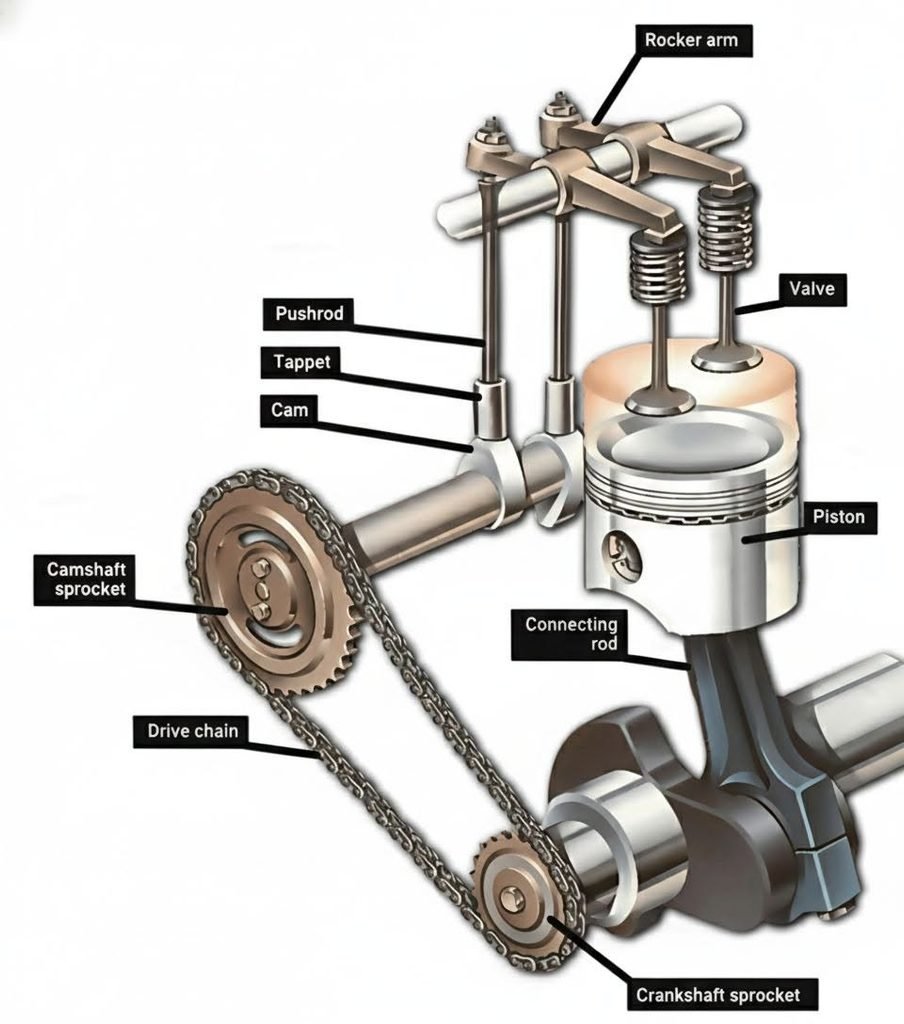
Before comparing OHV, SOHC and DOHC, we need to understand the job of the camshaft. An internal-combustion engine has to control the movement of gases into and out of its cylinders. During the intake stroke, the intake valves need to open so that air, or an air-fuel mixture depending on the engine design, can enter. After combustion, the exhaust valves must open to allow the burned gases to leave.
The camshaft controls this process.
A camshaft is a rotating shaft with specially shaped cam lobes. As these lobes rotate, they push on components in the valvetrain, causing the valves to open at precisely determined points in the engine cycle. The crankshaft and camshaft are mechanically synchronized, generally at a 2:1 speed relationship in a four-stroke engine: the crankshaft makes two revolutions for every one revolution of the camshaft.
That synchronization is critical.
If the valves open too early, too late, or remain open for the wrong amount of time, the engine’s breathing, power, efficiency and emissions can be affected. This is where the differences between OHV, SOHC and DOHC become important.
1. OHV — Overhead Valve
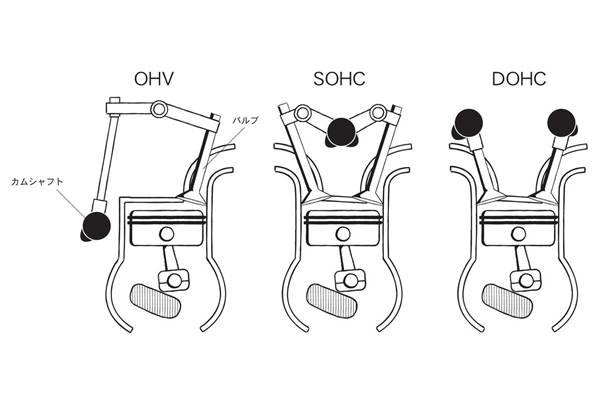
OHV stands for Overhead Valve. The important thing to understand is that the valves are located in the cylinder head, above the combustion chamber, while the camshaft is located in the engine block.
Because the camshaft isn’t directly beside the valves, the engine needs additional components to transfer the camshaft’s movement upward.
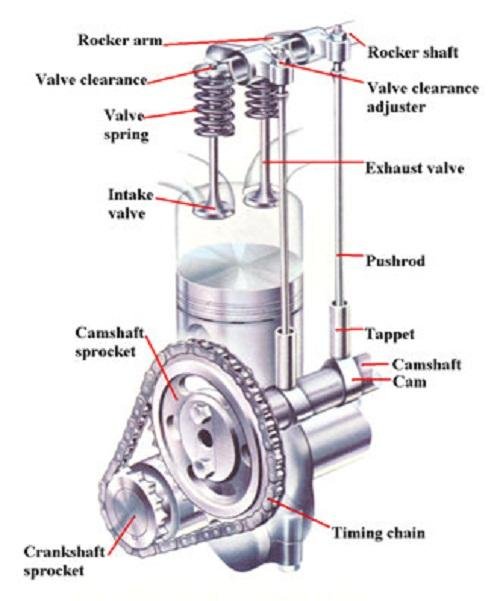
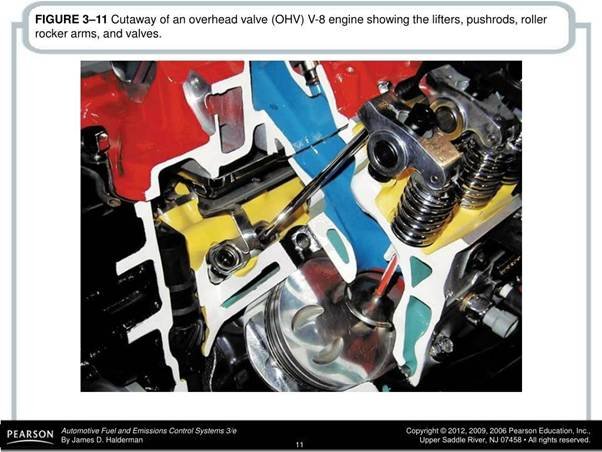
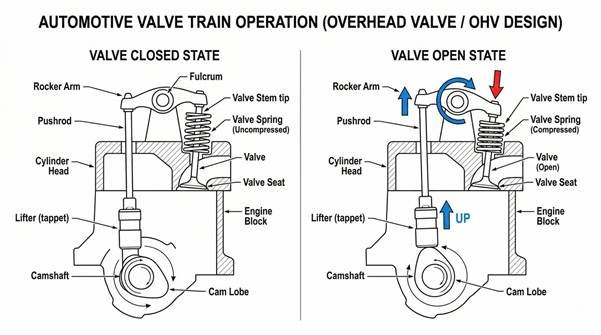
A typical OHV system uses: Camshaft, lifters/tappets, pushrods, rocker arms, valve springs, Intake and exhaust valves The camshaft pushes the lifter, the lifter moves the pushrod, the pushrod moves the rocker arm, and the rocker arm operates the valve. That is why OHV engines are commonly called pushrod engines.
How OHV works
Think of the system as a mechanical chain:
Crankshaft → Camshaft → Lifter → Pushrod → Rocker Arm → Valve
The camshaft remains relatively low in the engine, while the valves are positioned in the cylinder head.
Why was OHV used?
OHV architecture became particularly important because it could produce a compact engine package, especially in V-type engines. The camshaft sits within the engine block, which can contribute to a relatively compact overall engine height. The design has also been used extensively in engines where strong low-speed torque and packaging are important. OHV therefore became strongly associated with large-displacement engines, particularly V8s.
Advantages of OHV
1. Compact packaging: Because the camshaft is inside the engine block, the cylinder heads can be relatively compact.
2. Strong low-speed characteristics: OHV engines have historically been well suited to applications where substantial torque at relatively low engine speeds is desirable.
3. Mechanical simplicity in certain layouts: Although the valvetrain contains pushrods and rocker arms, an OHV V-engine can use a compact arrangement with a central camshaft.
4. Proven architecture: OHV technology has been developed for decades and remains relevant in some modern high-displacement engines.
Disadvantages of OHV
The major limitation is valvetrain mass and complexity between the camshaft and valves. Because the camshaft operates the valves through lifters, pushrods and rocker arms, there are more moving components between the camshaft and valve. At very high engine speeds, controlling all of these moving components becomes more challenging. The additional valvetrain mass can limit how aggressively the engine can operate at high RPM compared with some overhead-cam designs. This doesn’t mean an OHV engine cannot produce serious performance. It absolutely can. It simply means the engineering priorities are different.
2. SOHC — Single Overhead Camshaft
Now we move the camshaft.
SOHC stands for Single Overhead Camshaft.
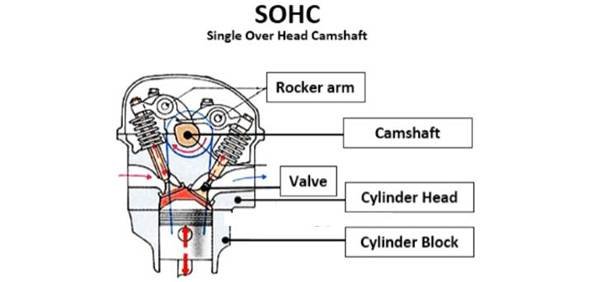
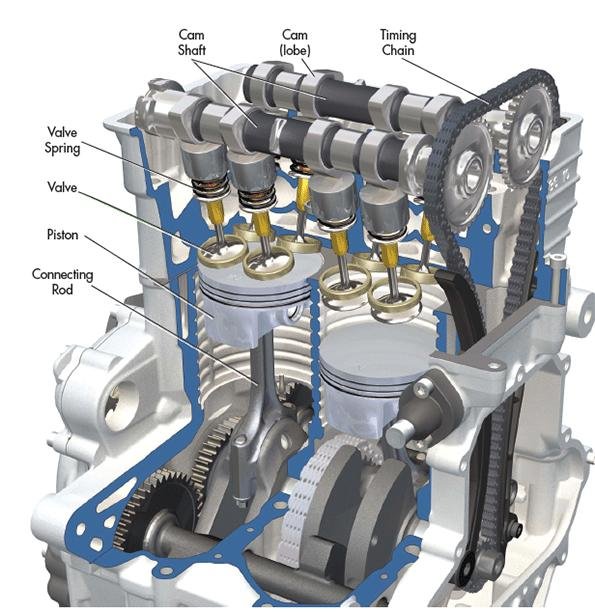
Instead of putting the camshaft inside the engine block, the camshaft is positioned above the combustion chamber, in the cylinder head. This removes the need for the traditional long pushrods used in OHV systems. A simplified SOHC arrangement looks like:
Crankshaft → Timing belt/chain → Camshaft → Rocker/Valve → Valve
The camshaft can operate the valves directly or through rocker arms, depending on the specific engine design.
What does “single” mean?
This is where many people misunderstand SOHC. “Single” does not necessarily mean there is only one camshaft in the entire engine, it means one camshaft per cylinder head/bank. For example, in an inline-four engine, there is one cylinder head, so a SOHC engine has one camshaft. But in a V6 or V8, there are two-cylinder banks. A conventional SOHC V-engine therefore has one camshaft for each cylinder bank, meaning two camshafts in total. This distinction is extremely important when reading engine specifications.
Why SOHC was an important development
Moving the camshaft into the cylinder head reduces the distance and number of components required to operate the valves. Compared with a conventional OHV arrangement, this can reduce valvetrain mass and allow the engine to operate more effectively at higher speeds. Honda, for example, describes OHC designs as reducing the number of valvetrain components and allowing them to be lighter and stronger. SOHC also provides greater flexibility in cylinder-head design. It can be used with: Two valves per cylinder, three valves per cylinder or some four-valve-per-cylinder configurations However, when an engine uses multiple valves and requires independent control of intake and exhaust valve timing, DOHC becomes particularly attractive.
3. DOHC — Double/Dual Overhead Camshaft
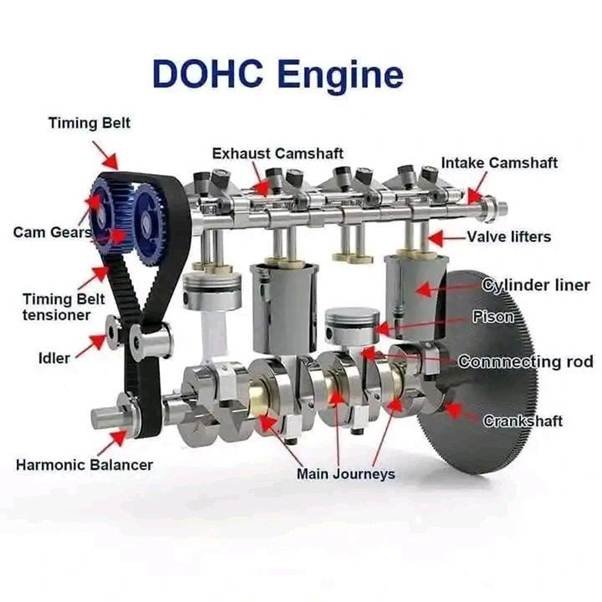
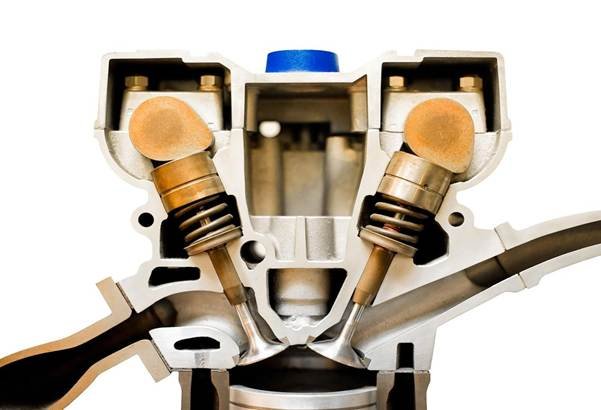
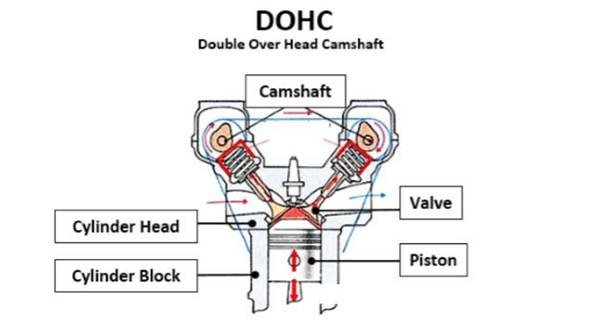
Then we arrive at the configuration that has become extremely common in modern passenger cars. DOHC stands for Dual Overhead Camshaft, also commonly described as Double Overhead Camshaft. Instead of one camshaft operating both intake and exhaust valves, DOHC uses two camshafts per cylinder head. One generally controls the intake valves while the other controls the exhaust valves. The basic arrangement is:
Crankshaft → Timing system → Intake Camshaft + Exhaust Camshaft → Valves
Why use two camshafts?
The biggest advantage is control. With separate intake and exhaust camshafts, engineers have greater freedom to determine exactly when the intake and exhaust valves open and close. This becomes particularly useful with engines that have four valves per cylinder. For example, a typical four-cylinder DOHC engine with four valves per cylinder has: 8 intake valves and 8 exhaust valve a total of 16 valves The two camshafts allow the intake and exhaust valve groups to be positioned efficiently within the cylinder head.
Why DOHC Became So Important
Modern engines are expected to deliver several things simultaneously: Power, fuel efficiency, lower emissions, smooth operation, strong low-speed response and high-speed performance. Achieving all of these requires increasingly sophisticated control of the air entering and leaving the cylinders. DOHC provides an excellent platform for technologies such as variable valve timing. Honda’s DOHC systems, for example, can independently manipulate camshaft timing to alter the timing of the intake process. This ability to manipulate valve timing across different engine speeds is one reason modern DOHC engines can deliver a broad operating range rather than being optimized for only one part of the RPM range.
OHV vs SOHC vs DOHC: The Fundamental Difference
The easiest way to understand the three systems is to ask one question:
Where is the camshaft?
| System | Camshaft location | Basic valve operation |
| OHV | Engine block | Lifters → pushrods → rocker arms → valves |
| SOHC | Cylinder head | One camshaft per cylinder head operates intake & exhaust valves |
| DOHC | Cylinder head | Separate camshafts generally operate intake & exhaust valves |
The fundamental evolution is therefore:
OHV → move the camshaft closer to the valves → OHC
Then:
SOHC → separate intake and exhaust camshafts → DOHC
OHV vs SOHC vs DOHC: Performance
It is tempting to say: “DOHC is better because it is more modern.” But that is too simplistic, the valvetrain is only one part of an engine. Power depends on numerous factors, including: Displacement, compression ratio, turbocharging, supercharging, valve size, valve timing, valve lift, cylinder-head design, fuel system, ignition system, engine management, exhaust system, intake system, RPM range. Therefore, you cannot determine an engine’s performance simply by seeing “OHV,” “SOHC” or “DOHC.” A well-engineered OHV engine can outperform a poorly designed DOHC engine. The architecture establishes the engineering possibilities; it doesn’t determine the entire character of the engine.
Why DOHC Is Common in Modern Performance Engines
One of the major advantages of DOHC is its ability to provide precise control over the intake and exhaust sides of the engine. This is especially valuable at higher RPM. As engine speed increases, the valves have less time to open and close. The valvetrain must therefore control them accurately and rapidly. Reducing unnecessary valvetrain mass and placing the camshafts close to the valves helps engineers manage this challenge. Overhead-cam layouts eliminate the long pushrod arrangement found in conventional OHV engines.
DOHC also works particularly well with: Variable Valve Timing The timing of the camshafts can be adjusted according to engine operating conditions. Variable Valve Lift The amount by which valves open can be altered in some systems. Four-Valve Cylinder Heads Two intake and two exhaust valves can provide substantial valve area while allowing relatively compact individual valves.
High RPM
The architecture lends itself well to engines designed to operate at high engine speeds.
But OHV Isn’t “Old and Bad” This is an important distinction. OHV has sometimes been portrayed as obsolete simply because many modern passenger cars use overhead-cam engines. That’s misleading. OHV remains an effective engineering solution for particular applications. Its compact packaging can be valuable, particularly for large-displacement V engines. And modern OHV engines can incorporate sophisticated technologies such as variable valve timing and cylinder deactivation. In other words, the question isn’t simply which architecture is newer. The question is, What was the engine designed to achieve? A large-displacement engine designed around strong torque, compact packaging and a particular vehicle architecture may benefit from OHV. A high-revving engine requiring extensive control of intake and exhaust valves may benefit from DOHC. A simpler engine that balances cost, packaging and performance may use SOHC.
What About SOHC?
SOHC occupies an interesting middle ground. It eliminates the long pushrods of OHV while using fewer camshafts than DOHC. That can make it a practical solution when an engine does not require the additional valve-control flexibility of a DOHC arrangement. SOHC can provide: Lower valvetrain complexity than DOHC. Good breathing capability, reduced valvetrain mass compared with pushrod designs, relatively straightforward packaging, good everyday performance. Ford’s technical glossary describes SOHC as using one camshaft atop each cylinder head to operate both intake and exhaust valves.
The Relationship With Number of Valves
The valvetrain architecture also affects how easily engineers can package multiple valves. Consider a four-cylinder engine. Two valves per cylinder. Each cylinder has 1 intake valve and an exhaust valve. Total: 8 valves while the Four valves per cylinder, each cylinder has 2 intake valves and 2 exhaust valves. Total: 16 valves. More valves can provide greater total valve area and allow engineers to optimize the flow of intake and exhaust gases. This is one reason DOHC became particularly attractive for modern multi-valve engines. Industry explanations of SOHC and DOHC commonly associate DOHC with four-valve-per-cylinder configurations, although SOHC can also operate four-valve heads with appropriate engineering.
What About Turbocharged Engines?
Here’s another important point: OHV, SOHC and DOHC have nothing inherently to do with whether an engine is turbocharged. A turbocharged engine can use an overhead-valve or overhead-cam architecture. The turbocharger forces additional air into the engine, while the valvetrain determines how the engine controls the intake and exhaust valves. So, you could have either of the three with turbocharged engine OHV, SOHC and DOHC in Everyday Car Shopping. When you’re looking at an imported vehicle, these abbreviations can tell you something about the engine’s architecture, but they shouldn’t be viewed in isolation. For example, if you’re comparing two SUVs, don’t conclude that the DOHC vehicle is automatically superior because it has two camshafts. Instead, look at: Engine architecture → displacement → power → torque → torque RPM → transmission → fuel consumption → vehicle weight → drivetrain → intended use.
For Kenyan buyers, that broader context can be especially important. A vehicle used primarily for Nairobi commuting has different requirements from one regularly travelling long distances or carrying heavy loads on rough roads.
A Simple Analogy
Imagine three people opening and closing doors. OHV, one person is downstairs and uses a long mechanical rod to operate a door upstairs. SOHC The person moves upstairs and operates both doors from one mechanism. DOHC Two people are upstairs, with one controlling the intake doors and another controlling the exhaust doors. That isn’t a perfect mechanical analogy, but it captures the central idea:
OHV uses a remote camshaft with pushrods; SOHC uses one overhead camshaft; DOHC uses two overhead camshafts for greater valve-control flexibility.
The Bigger Story: From Mechanical Simplicity to Precision
The evolution from OHV to SOHC and DOHC isn’t simply a story about old engines becoming new engines. It is a story about how engineers learned to control the breathing of an engine more precisely. OHV placed the camshaft inside the block and used pushrods and rocker arms to operate valves positioned in the cylinder head. SOHC moved the camshaft into the cylinder head, reducing the distance and components between the camshaft and valves. DOHC went a step further by separating intake and exhaust camshaft control, providing greater flexibility for multi-valve cylinder heads, high-speed operation and technologies such as variable valve timing. And this is why a simple three- or four-letter abbreviation on a vehicle specification sheet can tell you much more than you might initially think.
Final Takeaway
OHV:
The camshaft is in the engine block, while the valves are in the cylinder head. Pushrods and rocker arms transfer the camshaft’s movement to the valves. It is compact and remains useful in applications where its characteristics suit the engine.
SOHC:
A single camshaft sits above the valves in each cylinder head and controls both intake and exhaust valves. It offers a relatively direct valvetrain with fewer components than a traditional pushrod design.
DOHC:
Two camshafts sit above each cylinder head, generally separating intake and exhaust valve operation. This provides greater flexibility for multi-valve cylinder heads, variable valve timing and high-speed engine operation.
The most important lesson is this:
OHV, SOHC and DOHC don’t tell you which engine is automatically “better.” They tell you how the engine’s valve system is designed.
And once you understand that, reading an automotive specification sheet becomes much more meaningful—you are no longer just seeing “DOHC 16V” or “OHV V8.” You understand what is happening mechanically inside the engine.