

Ah, the long rains. Nature’s way of refreshing the earth, filling up our dams, and turning Waiyaki Way into a temporary branch of Lake Victoria.
Every rainy season, without fail, the script remains unchanged. The clouds open up over Nairobi, and within twenty minutes, every low-lying roundabout resembles a swimming pool. Then comes the bravado: a guy in a low-slung Demio looks at a two-foot deep flood on Ojijo Road, turns up his radio, and whispers to himself, “Ntabaki pale kwa maji kweli?”
Spoiler alert: Yes, you will.
Before the rain starts dropping like unannounced blackouts, your car needs a proper audit. We are talking about three critical battlegrounds: preventing the dreaded hydro-lock, keeping your electricals waterproof, and ensuring your tires actually hold the tarmac instead of turning your hatchback into a speedboat.

1. Hydraulic Lock: The KES 300,000 Mistake
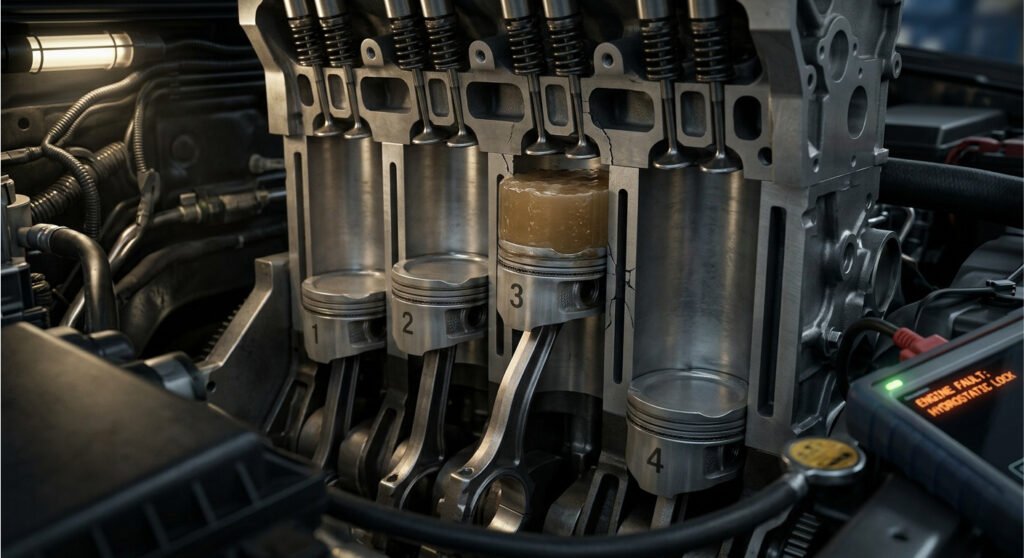
Let’s talk about Hydro-lock (Hydraulic Lock). It sounds like a sci-fi term, but in reality, it is just mechanical heartbreak.
Here is the quick chemistry and physics lesson: your engine runs by sucking in air, mixing it with fuel, compressing it with a piston, and setting it on fire. Air compresses easily. Water does not.
When your car gulps down water through the intake, that liquid rushes straight into the cylinder. The piston travels up to compress it, hits a literal brick wall of water, and… BANG.
Your connecting rods bend into pretzels, your cylinder block cracks open like an avocado, and your bank account cries a thousand tears. Suddenly, your mechanic fund requires a small parcel of land in Kitengela to resolve.
High-Risk Vehicles
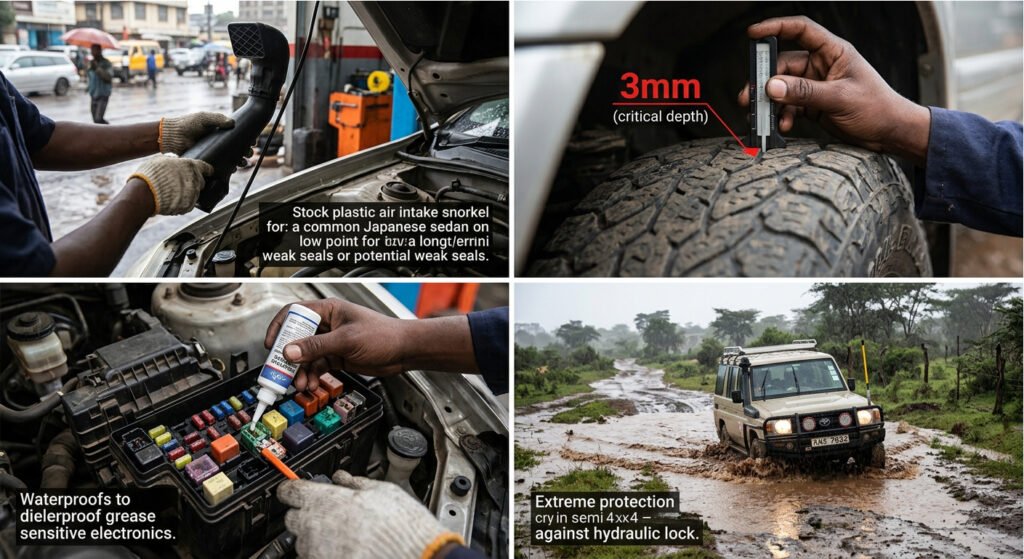
- Low-slung Intakes: Many modern Japanese imports—like your sleek Mazda Axela or Vitz—have their air intake scoops tucked right in the lower front bumper or wheel wells. They are built for pristine Tokyo asphalt, not the seasonal rivers of Mombasa Road.
- Modified Aftermarket Intakes: If you installed an exposed “cold air intake” cone filter right behind your lower grille for that extra 3 horsepower, congratulations: you’ve essentially attached a straw to your engine.
Preventive Steps Before the Rain Hits
- Check Your Air Box and Drain Valves: Pop the hood, open the air filter housing, and inspect it. Make sure the little rubber drain valves at the bottom of the air box aren’t choked with dust, leaves, or old plastic bags. If water splashes into the box, it needs a way to drain out before the engine sucks it in.
- Install a Hydro-Shield Outer Sleeve: If you have an exposed aftermarket filter, wrap it in a hydrophobic pre-filter mesh. It lets air through but makes water bead off like oil on a duck’s back.
- Inspect the Intake Ducting: Check for loose clamps or cracked hoses between the air box and throttle body. A small crack in a low hose acts as a vacuum hose for ground water.
| THE CARDINAL RULE OF FLOOD DRIVING |
| |
| If your car stalls in deep water, DO NOT TRY TO START IT AGAIN! |
| Turning the key forces the starter motor to drive the pistons against trapped |
| water, snapping your internal components instantly. Turn it off, step out, |
| and call a breakdown truck (or pay the local youth to push you out).
2. Waterproofing Electricals: Keeping the Dashboard Dark
If hydro-lock is the instant killer, electrical gremlins are the slow, agonizing fever. Modern cars are basically computers on wheels. When floodwaters hit your undercarriage, water finds every microscopic gap in your wiring.
Three weeks after the rains end, your check engine light comes on, your horn starts blaring at 3:00 AM by itself, and your power windows refuse to roll up while you’re parked outside the supermarket.
Target Areas to Weather-Seal
- Under-Hood Fuse Boxes: Locate your main relay and fuse box under the bonnet. Make sure the plastic lid clips on tightly and the rubber seal inside isn’t cracked or missing. If it looks tired, seal the perimeter with silicone grease.
- Battery Terminals & Grounds: Corrosion thrives in wet weather. Unbolt the terminals, scrub off that white/green powdery crust with baking soda and water, bolt them down tight, and smear a thick layer of dielectric grease (or petroleum jelly in a pinch) over the exposed metal.
- Exposed Wire Connectors: Look down near your bumper and lower engine bay. Connectors for your fog lights, ABS sensors, and transmission solenoids take a beating from road spray. Unplug them, spray contact cleaner, add a dab of dielectric grease inside the rubber boot, and snap them back together.
The Hidden Trap: Cowl Drains
See that plastic panel at the base of your windshield where the wipers sit? That’s the cowl. Rain runs off your windshield directly into this area, where factory drain holes route the water harmlessly down behind your front wheels.

The Problem: Over dry months, the cowl collects leaves, dirt, and dried acacia thorns.
The Disaster: When heavy rain hits, the clogged drains cause water to back up like an overfilled sink. It overflows straight through your firewall seams into the cabin footwells—submerging your main body control module (BCM) hidden under the carpet.
The Fix: Pop the hood, clear out the leaf mulch by hand, and run low-pressure water down the cowl to confirm it drains out behind the front tires instantly.
3. Tire Tread Depth: Stopping the Boat Effect
You are cruising down the highway at 80 km/h, the sky opens up, and suddenly your car feels light, floaty, and completely unbothered by your steering wheel inputs.
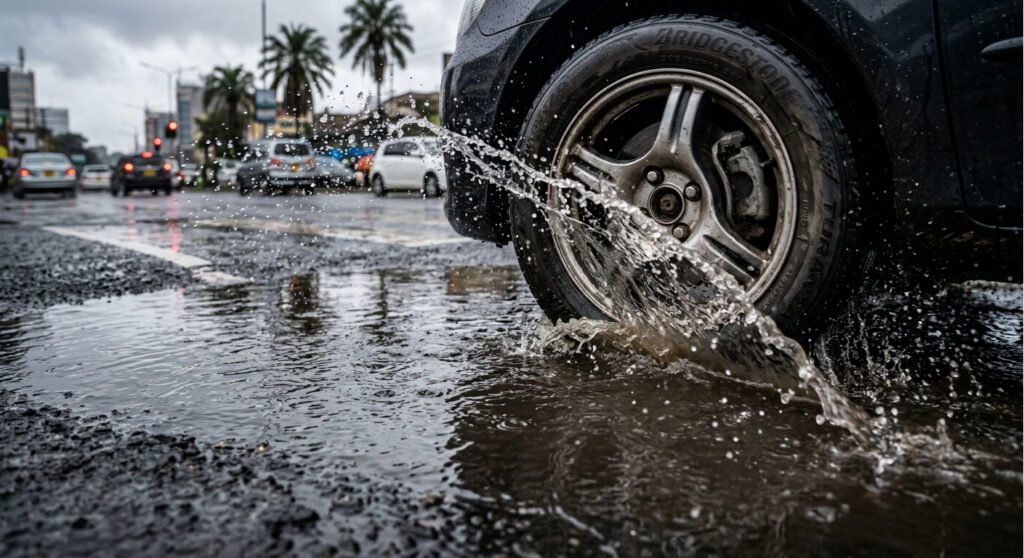
Welcome to Hydroplaning. Your tires have officially stopped touching the tarmac and are now water-skiing on a microscopic film of floodwater.
HYDROPLANING RISK vs. TREAD DEPTH
Tread Depth Water Evacuation Capacity Risk Level
6.0 mm+          100% (Optimal Channeling)        LOW
3.0 mm - 5.0 mm   60% - 80% (Moderate Clearance)  MODERATE
1.6 mm - 2.5 mm   20% - 40% (Severe Loss)         HIGH / CRITICAL
The Tread Depth Audit
Tread grooves act as channels to pump water out from underneath the rubber so it can maintain contact with the road. The shallower the groove, the less water it pumps.
Legal Minimum vs. Real-World Survival: The law says 1.6 mm (2/32 in) is legal. Real life says 1.6 mm in a torrential downpour will send you sliding sideways into a ditch. Once your tread drops below 3.0 mm (4/32 in), your wet braking distance doubles.
The Quick Check: Look for the Tread Wear Indicators (TWIs)—the tiny raised rubber bars inside the main grooves of your tire. If the tread surface is flush with those little bars, your tires are slicker than an oil spill. Replace them before the rain starts.
Tire Pressure & Rubber Condition
- Don’t Soften Your Tires: A common myth is that letting air out gives you more grip in wet weather. Wrong. An under-inflated tire bows inward in the center, closing up the vital water-evacuation channels and making hydroplaning worse. Stick strictly to your door-jamb pressure recommendations.
- Check for Dry Rot: Look at the sidewalls. If you see tiny spiderweb cracks from years of harsh sun, the rubber compound has hardened. Hard rubber cannot bite into wet asphalt, regardless of how deep the tread looks.
Quick Pre-Rain Checklist
Before you hit the road under dark skies, take 10 minutes to verify:
- [ ] Air filter box is dry, sealed, and clear of debris.
- [ ] Battery terminals are clean and coated with grease.
- [ ] Windshield cowl drains drop water cleanly onto the ground.
- [ ] Wipers leave zero streaks (replace worn rubber blades!).
- [ ] All four tires have at least 3 mm of tread depth and correct PSI.
- [ ] High-beam headlights and hazard lights function correctly for low-visibility rain.
Stay safe, drive sensibly, leave plenty of braking distance, and when you see a puddle of questionable depth—let the guy in the lifted 4×4 go first to test the waters!
Compiled by Sipitali Shitsukane
Automotive Enthusiast, Car Imports Consultant